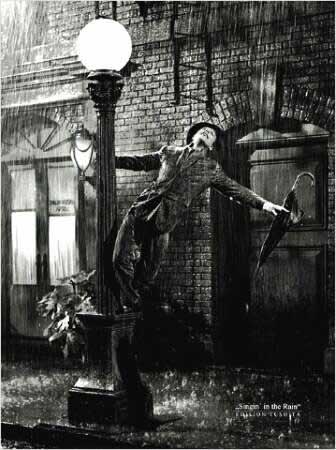
 Gene KellyGene Kelly
"Más que un bailarín"
A comienzos de este mes, recibí la triste noticia de que
Gene Kelly, una leyenda de la pantalla y mi ídolo personal, había muerto.
Numerosos tributos se le hcieron en las noticias mostrándolo bailando bajo la
lluvia, en París, o en la ciudad de Nueva York. Él siempre será joven,
congelado en el tiempo en su trabajo y en las alabanzas que reciba por su
dirección, actuación y baile son bien merecidas. Pero hay mucho más Gene
Kelly que la dirigir, actuar y sí, incluso bailar. Por lo que yo lloro es por
el paso de un gran hombre.
Muchos se preguntan por qué derramar lágrimas por alquien a quien nunca
conocí, alguien lo suficientemente mayor como para ser mi abuelo, alguien cuyos
logros cinematográficos tuvieron lugar décadas antes de mi nacimiento. Me
gustaría decirles a todos quién más era Gene Kelly:
Gene Kelly fue un abogado que luchó contra el racismo años antes del
Movimiento por los Derechos Civiles. En 1948 bailaba con dos de los bailarines
con más talento y más atléticos que hubieran estado nunca en la pantalla, los
Nicholas Brothers. Pero eran negros, y el estudio pensó que algunos teatros
cortarían el número. Gene insistió, y se podría decir que abrió la puerta a
algunos artistas con talento que estaban ocultos por el color de su piel.
Gene Kelly fue un hombre de familia. Cuando su segunda mujer enfermó de cáncer
en 1973, rechazó varios trabajos de dirección que le hubieran alejado de su
hogar. Y cuando ella murió, Gene aceptó pocos trabajos para ser madre y padre
de sus dos hijos, de 11 y 8 años.
Gene Kelly fue un inventor. Se le dijo que la toma "low-angle" que él
quería era imposible debido al tamaño de las cámaras technicolor. De
modo que inventó el "Ubangi", un mecanismo que se une a la cámara
para permitirle realizar esa toma.
Gene Kelly fue honesto. Estaba demasiado orgulloso de su herencia para cambiar
su nombre en Broadway. Y se quejó al departamento de publicidad de la MGM
cuando cubrieron la cicatriz de su cara. No era perfecto, y él no quería
ser visto como una estrella, sino como uno de los muchachos.
Básicamente, Gene Kelly fue el precursor de la filosofía "Simplemente,
Hazlo" ("Just Do It"). Años antes de Roger Rabbit. se le dijo
que era imposible bailar con un dibujo animado, y él encontró la manera.
Cuando se le dijeron que los musicales filmados en exteriores serían
increíbles, cambió la historia musical. cuando se le dijo que nunca lo
haría grande, bueno, afortunadamente para todos nosotros, él sólo eschuchó a
su corazón.
De modo que aunque Gene Kelly fue un gran director, un actor con talento (cuyos
papeles dramáticos necesitan mayor atención), y el bailarín más innovador,
también fue un gran hombre, uno que admiro porque se propuso llevar a cabo
cualquier sueño que pudiera imaginar, y tuvo éxito.
Gracias, Gene, por hacerme creer que puedo realizar cualquier cosa con un poco
de trabajo duro.
D. J. Pointkouski
Philadelphia
(CARTA ORIGINAL EN INGLÉS)
"More than a dancer"
Earlier this month, I was deeply saddened to learn that Gene Kelly, a screen
legend and my personal idol, had died. Numerous tributes appeared in the news
showing him dancing in the rain, in Paris, or on the town in New York.
He is forever young, frozen in time by his work, and any accolades he receives
for directing, acting, and dancing are well deserved. But there is so much more
to Gene Kelly than directing, acting, and yes, even dancing.
The passing of a great man is why I mourn.
Many wonder why I shed tears for a man I never met, one old enough to be my
grandfather, one whose glorious cinematic achievements were during an eradecades
before my birth. I'd like to tell everyone who else Gene Kelly was:
Gene Kelly was an advocate who fought racism years before the Civil Rights
Movement. In 1948 he danced with two of the most talented and athletic male
dancers ever to grace the screen, the Nicholas Brothers. But they were black,
and the studio balked that some theaters would cut the number. Gene insisted,
and some now say he opened the door to many talented performers that were hidden
by the color of their skin.
Gene Kelly was a family man. When his second wife was dying from cancer in 1973,
he refused directing assignments that would take him far from home.
After she died, he accepted very few jobs in order to be both mother and father
to his two children aged 11 and 8.
Gene Kelly was an inventor. He was told that a low-angle shot he wanted was
impossible because of the size of Technicolor cameras. So he invented the “Ubangi,”
a mechanism that attaches to the camera to permit the shot he wanted.
Gene Kelly was honest. He was too proud of his heritage to change his name on
Broadway. Then he yelled at MGM's publicity department when they covered up his
facial scar. He wasn't perfect, and he didn't want to be seen as a “star,”
just as one of the guys.
Basically, Gene Kelly was the forerunner of the “Just Do It” philosophy.
Years before Roger Rabbit, he was told it wasn't possible to dance with a
cartoon, but he found a way. When he was told musicals filmed outdoors would be
unbelievable, he changed musical history. And when he was told he'd never make
it big, well, fortunately for all of us, he listened to his heart instead.
So although Gene Kelly was a great director, a talented actor (whose dramatic
roles need to be heralded more), and the most innovative dancer ever, he was
also a great man, one that I admire because he set his mind to fulfilling any
dream he imagined, and he succeeded.
Thanks, Gene, for making me believe I can accomplish anything with a little hard
work.
D. J. Pointkouski
Philadelphia